 Feng Ruohang
87746913fc
Feng Ruohang
87746913fc
The replication sender's target HEAD carries no SSE-C customer key, so for
an SSE-C object the target answers 400 and replicateAll fell into a
metadata-only CopyObject that fails on any non-empty SSE-C object (the
undecryptable source checksum makes the target recompute one and rewrite
the data with a plaintext-sized reader). Once a non-empty SSE-C replica
existed, tag, retention and legal-hold changes never reached it, a heal
never retransmitted, and a resync neither repaired the replica nor
counted it correctly. Forcing a full retransmit alone was not enough:
checkPreconditionsPUT rejects a write whose PreserveETag and VersionID
match the stored version, only the single-part sealed ETag is truncated
before that comparison, so a multipart SSE-C retransmit answered 412,
which the sender turns into success. Inherited from upstream ad04afe38.

Select replicateAll when the SSE-C HEAD cannot answer (the two previous
assignments were dead: rAction still forced the metadata path), exempt an
authenticated replica write that carries an SSE-C seal from the duplicate
version and ETag rejection (the predicate is the incoming write's
restored SSE-C metadata, not what the destination holds), and send the
internal replication marker on the resync accounting HEAD for SSE-C
objects so a peer answers with the replica metadata instead of 400.

Tests: TestAPISSECReplicaRetransmitOverExistingVersion (multipart replica
initiation over the same version and ETag answered 412 on main, now 200
with parts sent and plaintext readback; single-part and zero-byte writes
unchanged), TestAPISSECReplicaWriteExemptionIsKeyedOnTheIncomingWrite
(plaintext replica over an SSE-C version still 412; SSE-C replica over a
plaintext version exempted and readable), and
TestAPISSECReplicationTargetHead (keyless HEAD 400, missing key 404,
marked HEAD 200 with metadata, metadata CopyObject ExcessData on a
non-empty object) on ErasureSD and Erasure. Compatibility: every update
of an SSE-C object now retransmits its bytes; a peer that rejects the
internal marker fails the accounting HEAD as before; the #109 destination
fix must be deployed first or a retransmitted replica is transformed
again.

Fixes pgsty/silo#120

Co-Authored-By: Claude Fable 5.1 <noreply@anthropic.com>
Claude-Session: https://claude.ai/code/session_01L7qJqWwy8oFA6aCXWRzXQe
Signed-off-by: Feng Ruohang <rh@vonng.com>

S3-compatible object storage — a MinIO fork maintained by PGSTY
Website · Documentation · Download · Release Notes · Compatibility · Manifesto · Security · 中文





Important
PGSTY Silo (hereinafter “Silo”) is an independent, community-maintained fork of the open-source MinIO server, published by Pigsty from
pgsty/silo. It is not affiliated with, endorsed by, or sponsored by MinIO, Inc. “MinIO” is used only to identify the upstream project and compatibility lineage.
Note
Renamed from
pgsty/miniotopgsty/silo, default branchmaster→main, on 2026-08-06. Artifacts under the original MinIO identity stay published on the archivedminiobranch and in releases up toRELEASE.2026-08-04T00-00-00Z.
Overview
PGSTY SILO keeps one maintained release line of the open-source MinIO server alive after upstream ended community distribution: builds, packages, multi-arch images, security fixes, and the full web console. Pigsty runs it in production as its PostgreSQL backup repository.
It follows one rule — the product and its delivery surfaces are renamed; the protocol and your data are not. Everything else lives on silo.pgsty.com.
Related: pgsty/mc client (shipped as mcli) · pgsty/silo-console · pgsty/silo-pkg · pgsty/pigsty
Quick Start
docker run -d --name silo -p 9000:9000 -p 9001:9001 \
  -e MINIO_ROOT_USER=minioadmin \
  -e MINIO_ROOT_PASSWORD=change-me-long-password \
  -v "$PWD/data:/data" \
  docker.io/pgsty/silo:latest server /data --console-address ":9001"
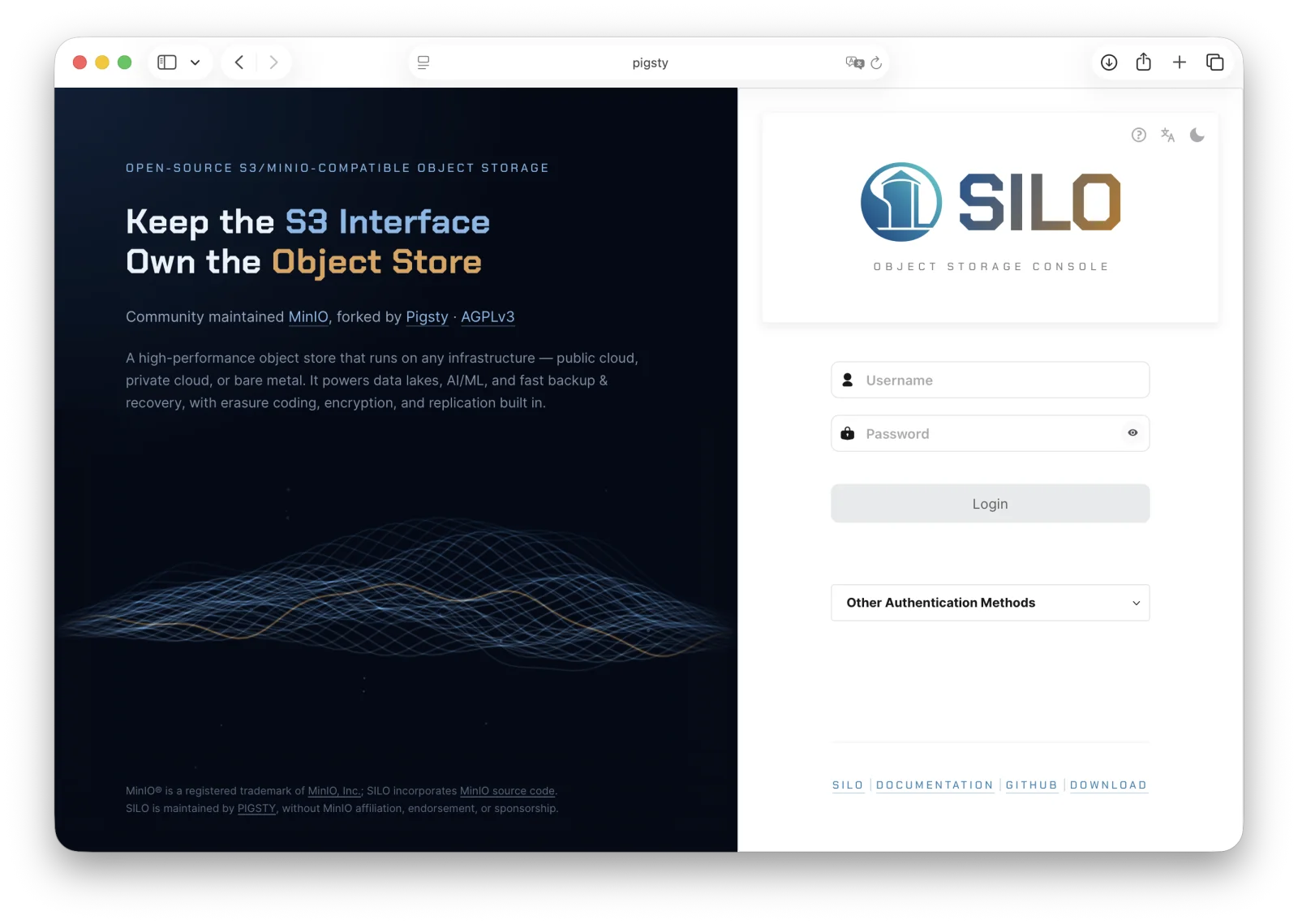
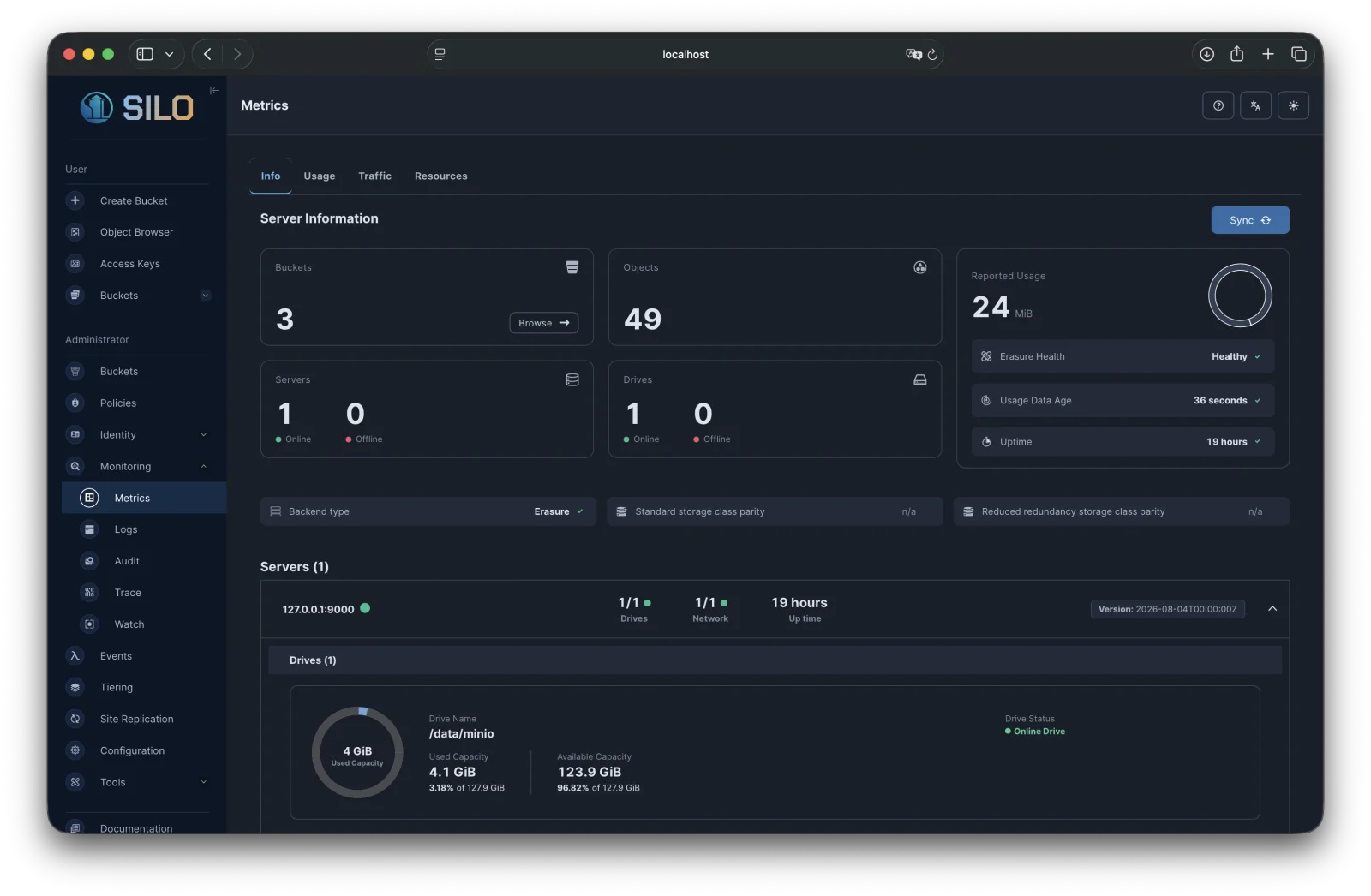
Console on http://localhost:9001, S3 API on http://localhost:9000. The image bundles the client as mcli:
docker exec silo mcli alias set local http://127.0.0.1:9000 minioadmin change-me-long-password
docker exec silo mcli mb local/demo && docker exec silo mcli ls local
Warning
For production, pin a release, use unique credentials and TLS, monitor the service, keep independent backups, and test recovery. Start from the documentation.
Install
| Method | Where |
|---|---|
| Container | pgsty/silo, multi-arch for linux/amd64 and linux/arm64 |
| Binaries | GitHub Releases — Linux, macOS, Windows on amd64 and arm64 |
| Packages | RPM, DEB, and APK, also via the Pigsty repository |
| Kubernetes | Helm chart, see Download & Install |
| Source | go build -o silo . && ./silo --version |
Every release ships checksums, SPDX SBOMs, Sigstore-signed manifests, and GitHub build attestations. Installation methods and verification commands are documented at Download & Install; migrating from upstream MinIO — taking over an existing minio.service and its /etc/default/minio, and keeping data ownership stable with a /etc/systemd/system/silo.service.d/10-legacy-user.conf drop-in — is covered by the migration guide and the binary & service notes.
Compatibility
The S3 API, MINIO_* variables, minio_* metrics, x-minio-* headers, /minio/* routes, the github.com/minio/* import paths, and the on-disk format (including .minio.sys) are preserved and held in place by a CI compatibility check. Only Silo-owned delivery surfaces change: the silo executable, package, service, Helm chart, and container image — no minio binary alias is installed.
Every divergence from upstream is listed in the code-verified compatibility audit. Treat each release as a downstream upgrade: pin versions, read the release notes, and keep a rollback path.
Security & Contributing
Report vulnerabilities privately as described in SECURITY.md; every fix ships with a public advisory. Contributions are accepted inbound=outbound under AGPL-3.0-or-later with no CLA — only DCO sign-off (git commit -s) is required; see CONTRIBUTING.md.
Contributors
The cards highlight community changes merged into main; the avatar wall includes every other
community member who has opened an issue or pull request.
 @h5vx Per-bucket CORS · #71 |
 @ycjlin Missing-bucket listing · #37 |
 @Dansyuqri Multipart checksum type · #57 |
 @pinginfo Notification streaming · #34 |
 @ZouhairCharef CVE-2026-34986 · #18 |
 @mfredenhagen CVE-2026-39883 · #19 |
 @waterkip Documentation links · #41 |







GitHub does not generate a contributor graph for forks, so CONTRIBUTORS.md — not the Insights page — is this project's attribution record. It names all 37 community contributors alongside the change or report they contributed.
Background
Upstream wound down its community edition: the web console was cut back to a stub, prebuilt community binaries stopped, and the community repository was archived. Silo exists to keep those deployments running. The fork is a means, not an identity — if upstream restores its community edition, we will narrow our scope and offer the fixes back.
The Manifesto is the project's public commitment in eleven articles, under one discipline: every article is either something already done with public evidence, or something explicitly refused. In short:
- Compatibility contract — the protocol and your data do not change, and every release documents its tested rollback target and path.
- The license cannot change — AGPLv3, no CLA, no copyright aggregation; nobody here, ourselves included, holds enough copyright to relicense on everyone else's behalf.
- The never list, append-only — no paywalling existing features, no registration wall on downloads, no telemetry (upstream's phone-home paths are removed outright), no CLA, no license change, no trademark enforcement against normal use.
- Security and release discipline — a public advisory for every fix, and a release every one to two months, at most a quarter apart. Judge both against the public record.
Essays: MinIO Is Dead · Who Takes Over? · Long Live MinIO · Promise Kept
License & Trademark
Silo is AGPL-3.0-or-later, derived from minio/minio with upstream copyright and third-party notices preserved in NOTICE and CREDITS. MinIO is a trademark of MinIO, Inc.; the name is used here only to identify the upstream project and compatibility lineage.
Details: license · attribution · trademark